―An innovative environmental monitoring approach enabled by Space–Biodiversity integration―
Researchers) YAMAMOTO Satoru Research Team Leader, MATSUOKA Moe Researcher, IKEDA Ayame Researcher, MIZUOCHI Hiroki Senior Researcher, Geological Survey of Japan, IGUCHI Akira Research Team Leader, Integrated Research Center for Nature Positive Technology
- Developed a new method that enables remote sensing retrieval of chlorophyll-α concentrations—an indicator of biological activity—in coastal areas, overcoming limitations of conventional approaches.
- Applied data mining techniques to hyperspectral data from HISUI aboard the International Space Station, successfully decoding a characteristic “double peak” spectral feature in the near-infrared region.
- Toward the realization of Nature Positive, this technology is expected to serve as a new space-based environmental monitoring tool for continuously observing changes in coastal ecosystems, through the integration of space science and biodiversity research.
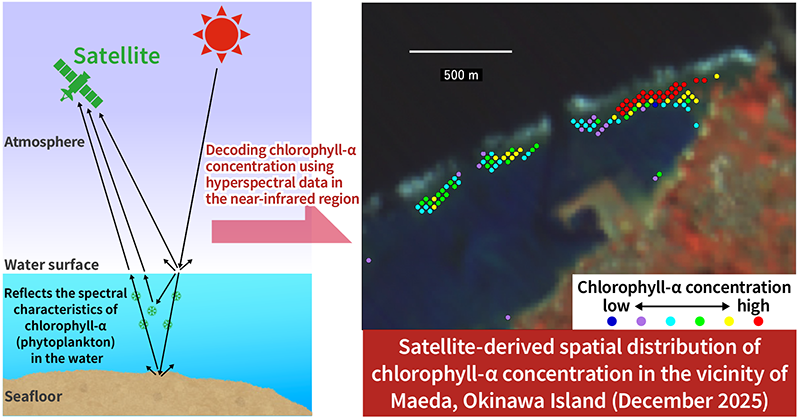
※This figure is based on and modified from the original paper.
Effectively monitoring environmental changes in marine areas is essential for achieving a nature-positive future. Coastal regions are highly susceptible to changes in water quality and ecosystems caused by nutrients inflows from land, driven by human activities such as development and tourism. Even areas that appear to retain beautiful coral reefs and rich natural environments may in fact be experiencing gradual environmental degradation. Therefore, there is a need for methods that continuously and efficiently assess the state of coastal environment. However, large-scale and long-term monitoring remains difficult through field surveys alone. In addition, environmental assessments conducted solely by developers can raise concerns regarding transparency and objectivity.
Consequently, there has been growing interest in monitoring the marine environment using satellite remote sensing. Traditionally, such observations have focused on chlorophyll-α pigment common to photosynthetic organisms including phytoplankton. Because chlorophyll-αabsorbs light at specific wavelengths, it is widely used not only as an indicator of phytoplankton abundance but also as a proxy for photosynthesis actively.
In ocean waters, higher chlorophyll-α concentrations cause the color of the sea to turn blue to green, as chlorophyll-α strongly absorbs blue light and reflects green light. Conventional satellite monitoring has relied on changes in ocean color, measured as reflectance in visible wavelengths. While this method is effective in the open ocean, where phytoplankton primarily governs ocean color, it has been proven challenging in coastal areas. This is because ocean color signals in such regions are significantly influenced by seafloor reflection, suspended matter, and dissolved organic matter from land. These factors make it difficult to accurately estimate chlorophyll-α concentrations.
Researchers at AIST, in collaboration with Associate Professor MIZUYAMA Masaru at Meio University, have developed a new spectral analysis method to estimate chlorophyll-α concentrations, an indicator of biological productivity in the ocean, using hypserspectral data from HISUI (Hyperspectral Imager Suite) aboard the International Space Station (ISS). The researchers demonstrated that this method enables the estimation of chlorophyll-α concentrations even in coastal waters, which conventional ocean-color approaches have significant limitations.
Even coastal areas that appear to maintain beautiful coral reefs and rich natural environments may be undergoing gradual environmental degradation due to human activities such as coastal development and tourism. Achieving a nature-positive future, one in which such environmental changes are reversed, requires systems that can monitor environmental changes objectively, continuously, and efficiently. Satellite-based remote sensing is expected to play an increasingly important role in this respect.
Conventional satellite observations estimate chlorophyll-α concentrations from changes in ocean color, based on reflectance in the visible wavelength range. However, the applicability in coastal areas is limited due to the significant influence of seafloor reflections and various substances originating from land.
In this study, by applying data mining to HISUI hyperspectral data, we identified characteristic “double-peak” spectral features appearing around 710 nm and 800 nm in the near-infrared region. These features serve as a new indicator of chlorophyll-α concentrations in shallow coastal waters. Furthermore, in coastal areas where these features were observed, we conducted in-situ spectroscopic measurements and chlorophyll-α concentration measurements to clarify and validate the relationship between the spectral features and chlorophyll-α concentration.
This method enables space-based monitoring of environmental changes in coastal areas that are highly susceptible to human activity. By using chlorophyll-α concentration as an indicator, it is expected to contribute to a new environmental monitoring technology for continuously observing changes in coastal ecosystems, including coral reefs, from space.
The details of this research were published in the “Journal of Geophysical Research: Biogeosciences” on March 7, 2026.