―Development of a Novel Screening Technology for Glyco-immune Checkpoint Molecules―
Researchers) Hiroaki Tateno, Researcher, Cellular and Molecular Biotechnology Research Institute
- Developed the GlycoChat method to comprehensively explore glycan-lectin interactions within cancer tumor tissues
- Using this method, identified endogenous lectins expressed on macrophages that interact with pancreatic cancer cell glycans and contribute to immune suppression
- Enabled the identification of immune checkpoint molecules associated with glycans, providing a foundation for developing novel inhibitors targeting them
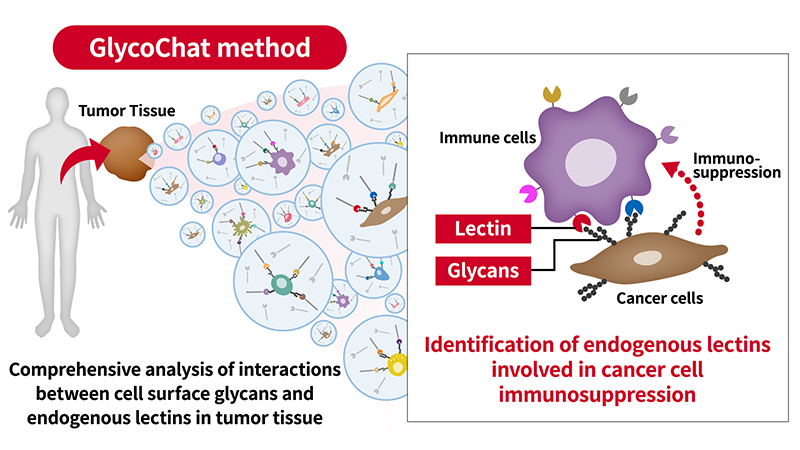
※ This figure is based on and modified from the original paper.
Both humans and other animals use their immune systems to protect their bodies from foreign invaders and the proliferation of cancer cells. The immune system has control functions, called immune checkpoints, that prevent reactions against normal tissues. However, some cancer cells “exploit” these checkpoints, causing immune cells to “mistakenly” identify them as non-targets, thereby enabling proliferation. Immune checkpoint inhibitors, which are used in cancer treatment, are drugs that prevent cancer cells from exploiting these immune checkpoints, thereby enabling immune cells to attack cancer cells. While these drugs are effective at suppressing the growth of certain cancers, they can cause side effects due to the excessive activation of immune cells attacking healthy tissues.
Recent studies have revealed that glycans on the surface of cancer cells interact with lectins expressed on immune cells, thereby suppressing immune cell function. These glycan-lectin interactions may serve as novel immune checkpoints involved in cancer immune evasion and appear to regulate immunity through mechanisms distinct from those of conventional protein-protein interactions involving immune checkpoint pathways. Such glycan-mediated immune regulatory mechanisms hold promise as novel therapeutic targets for refractory cancers, such as pancreatic cancer, in which current immune checkpoint inhibitors have demonstrated only limited therapeutic efficacy.
In collaboration with researchers at the University of Tsukuba, researchers at AIST have developed a novel method called the “GlycoChat” to comprehensively explore glycan-lectin interactions within tumor tissues. Using the GlycoChat method, they revealed glycan-mediated interactions between pancreatic cancer cells and macrophages that suppress antitumor immune response.
Recent studies have demonstrated that glycans attached to proteins on the surface of cancer cells can bind to lectins expressed on immune cells, functioning as immune checkpoints that enables cancer cells to evade immune surveillance. This glycan-lectin-mediated immune regulatory mechanism shows promise as a novel therapeutic target for refractory cancers, including pancreatic cancer. However, identifying the glycan-lectin pairs involved in immune suppression requires investigating the interaction strength between glycans expressed by various cells within tumor tissues and the lectins present on immune cells—a process that is both labor-intensive and time-consuming.
We have developed a novel method, called GlycoChat, to comprehensively explore glycan-lectin interactions within tumor tissues. By applying this method to tumor samples from patients with pancreatic cancer tumor, we successfully identified endogenous lectins expressed on macrophages that interact with pancreatic cancer cell glycans and contribute to immune suppression. GlycoChat enables the identification of glyco-immune checkpoint molecules in refractory cancers, such as pancreatic cancer, and provides a foundation for the development of novel inhibitors that target these molecules through previously unexplored mechanisms. Details of this research were published in Advanced Science on January 14, 2026.
Publication: Advanced Science
Title: GlycoChat uncovers glycan-lectin circuits in the tumor microenvironment of pancreatic cancer
Author: Anh Dinh Xuan Tuan, Sunanda Keisham, Arun Burramsetty, Lalhaba Oinam, Koichiro Kumano, Akihiro Kuno, Osamu Shimomura, Tatsuya Oda, Hiroaki Tateno (CA)
DOI:10.1002/advs.202514735