―Achieving the world's highest-performance printable transparent conductive film through a dispersion process that preserves CNT structure―
Researchers) ZHOU Ying, Senior Researcher, Nanocarbon Material Research Institute
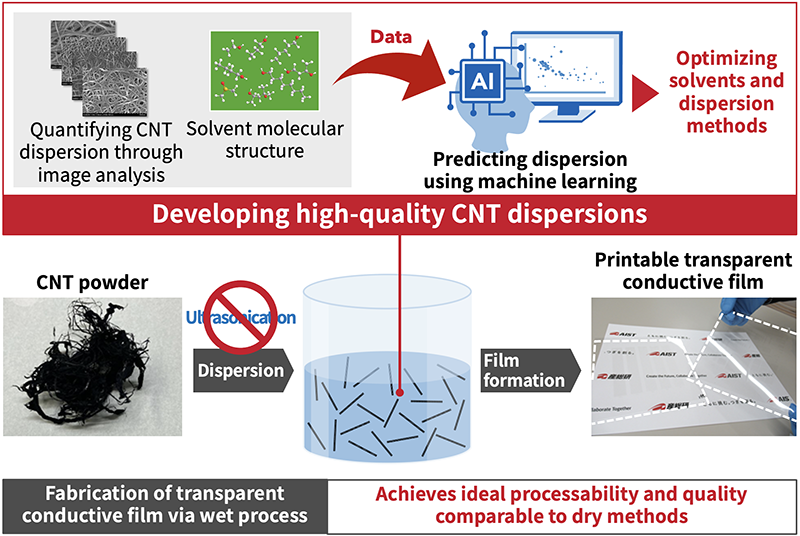
- Using machine learning, we developed a method to select the optimal solvent for dispersing carbon nanotubes (CNTs) in liquid. This method allows us to obtain high-quality CNT dispersions without relying on ultrasonic processing.
- Through this optimized CNT dispersion process, we achieved the world's highest performance in printed transparent conductive films using a highly scalable manufacturing method.
- This method is expected to expand the range of applications for CNTs, including transparent conductive films used in touch panels and solar panels, as well as next-generation battery materials.
AI-Guided Optimization of CNT Dispersion Processes
Carbon nanotubes (CNTs) are a next-generation nanomaterials composed of carbon atoms linked together in tubular structures. They are lightweight yet possess high strength, electrical conductivity, and thermal conductivity. Thanks to these exceptional properties, CNTs are being used in many different fields such as battery electrodes, conductive resins, and flexible devices. CNTs have now become a practical material, with global annual production exceeding 10,000 tons.
High conductivity among these devices is achieved when sufficiently long CNTs form a network of randomly oriented cross-linked structures. However, CNT raw materials are bound together by van der Waals forces and π-π interactions, so they must be separated and dispersed. There are two methods for fabricating devices that utilize highly dispersed CNTs: dry and wet processes. While CNTs produced by the dry method retain high crystallinity, this method presents challenges such as high cost and limited applications. Consequently, the wet method, in which a CNT solution is coated onto a substrate to fabricate thin-film devices, is commonly adopted in general industrial processes due to its high scalability, ease of large-area fabrication, and low cost.
However, ultrasonic treatment is frequently used in the wet method and carries a high risk of inducing defects in CNTs. This poses a significant obstacle for manufacturing devices that require high conductivity. A wet method that does not require ultrasonic treatment could enable the production of high-performance, transparent electrodes with excellent light transmittance for CNT device fabrication. This would expand applications in touch panels and solar panels.
As researchers at AIST, we have developed a method for obtaining high-quality carbon nanotube (CNT) dispersions to form highly conductive CNT thin films.
Devices that leverage the high conductivity of CNTs are increasingly being used in industry as electrodes in touch panels and solar panels. In the wet manufacturing method, which involves coating a substrate with a CNT solution, the dispersion of the CNTs in the solution determines the performance of the device. However, achieving defect-free CNT dispersion is not easy. To create CNT solutions with high dispersibility and properties tailored to the type of device being manufactured, it is important to select the appropriate solvents and dispersants. It is also important to use a dispersion process that does not rely on methods such as ultrasonic treatment because these methods may induce defects in the CNTs.
Here, we developed a method to optimize the dispersion process of CNTs using the wet method. This method integrates various analytical techniques, including AI technology (specifically machine learning), molecular dynamics simulations, and solubility parameters. Using this method, we successfully fabricated a transparent, conductive CNT film whose performance is comparable to that of the dry method. This demonstrates the applicability of this technology to low-cost, large-area CNT thin film manufacturing processes, like printing and coating. It is expected to expand the range of industrial applications for CNTs such as transparent conductive films and next-generation battery materials.
Details of this research will be published in Advanced Functional Materials on January 21, 2026.
Journal: Advanced Functional Materials
Title of paper: Rational design of printable carbon nanotube transparent conductive films via data-driven and mechanistic insights
Authors: Ying Zhou, Ken-ichi Nomura, Shun Muroga, Makoto Yoneya, Don N. Futaba, Takeo Yamada, Reiko Azumi, Kenji Hata
DOI:10.1002/adfm.202524038