Researchers) NAKAYAMA Hiroyasu Senior Researcher, NOZAKI Takayuki Attached to Research Group, YAMAJI Toshiki Senior Researcher, NOZAKI Tomohiro Research Group Leader, IMAMURA Hiroshi Attached to Research Group, Research Institute for Hybrid Functional Integration, YUASA Shinji Senior Principal Researcher, Department of Electronics and Manufacturing
- By applying a voltage to the interface of an artificial antiferromagnet consisting of a non-magnetic thin film sandwiched between two ferromagnetic layers, the team successfully wrote magnetic information stably across a wide range of pulse widths.
- This paves the way for voltage-driven MRAM (Magnetoresistive random-access memory) with higher capacity.
- Both data retention and writing operations can be performed with ultra-low power consumption, contributing to energy savings in information devices.
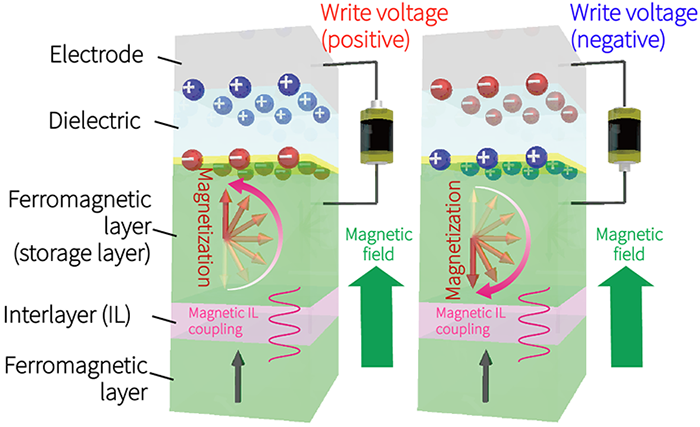
Conceptual diagram of the voltage-based magnetic data writing technology developed by the research team
Researchers at AIST have developed a technology called the “voltage-induced static magnetization reversal method,” as a new method for writing magnetic data. This method enables voltage-driven MRAM (Magnetoresistive RAM) with higher capacity, and the researchers have successfully observed its operation experimentally.
Non-volatile memory retains data even when the power is turned off, resulting in zero standby power consumption. It is expected to contribute significantly to energy savings in information devices. Among these, MRAM, which controls the spin state of electrons, is particularly well-suited for integration into processing chips. It is a type of non-volatile memory that offers extremely fast read/write speeds and excellent robustness against environmental factors such as radiation and temperature. However, current MRAM requires a large amount of current to stably control information, and the resulting increase in power consumption during writing has been a major challenge. On the other hand, while voltage-driven MRAMs currently under development allow for low-power writing, voltage-based writing requires the generation of high-precision, high-speed voltage pulses, and has faced the problem of write errors occurring due to even slight variations in the write voltage. Additionally, because the optimal write voltage pulse width varies for each device due to variations in device characteristics, achieving stable operation and higher capacity in voltage-driven MRAMs has been difficult using conventional writing methods.
Researchers at AIST have developed a technology that uses an “artificial antiferromagnet”, a sandwich structure consisting of a non-magnetic thin film sandwiched between two layers of ferromagnetic thin films, to control the preferred magnetization orientation of the ferromagnetic layer (the direction of the N and S poles, which correspond to the digital states 0 and 1) by applying a voltage. The team also demonstrated that magnetic information can be written in both directions depending on the polarity of the applied voltage. Furthermore, they also showed that writing remains stable even when the pulse width of the writing voltage changes. Since this technology enables stable, controllable data writing with low power consumption, it is expected to be applied to future high-capacity non-volatile magnetic memory.
The widespread adoption of artificial intelligence (AI) and the Internet of Things (IoT) has led to a rapid increase in the volume of information handled by society. As a result, the amount of electricity consumed for the temporary storage and processing of this information continues to rise. Therefore, further improving the energy efficiency of information devices, including computers, is critical to achieving a sustainable society. In information devices, the parts that temporarily store data include volatile memory and non-volatile memory. Volatile memory requires power to retain information, whereas non-volatile memory retains information even when the power is off. Since non-volatile memory inherently does not require power to retain information, it is generally considered more energy-efficient than volatile memory. SRAM (Static RAM) is a representative example of the “semiconductor memories” that serve as fundamental components of computers. It offers excellent characteristics, such as extremely fast data writing at low power consumption and virtually unlimited rewrites. However, because it is a volatile memory, its power consumption even during standby is a significant issue.
In contrast, MRAM is a non-volatile memory that retains information by utilizing the spin state of electrons (the property of electrons that gives rise to magnetism). MRAM is easy to integrate into processing chips and offers high read and write speeds. It also exhibits high resistance to harsh environments such as radiation and high temperatures. However, current MRAM, also known as STT-MRAM, uses a method that employs electric current to write data. As a result, it consumes significantly more power during writing compared to SRAM. Developing technologies that reduce this power consumption has been a critical research challenge.
Journal:Nature Materials
Title of paper:Static magnetization switching in an artificial antiferromagnetic multilayer driven by a voltage-controlled magnetic anisotropy effect
Authors:Hiroyasu Nakayama, Takayuki Nozaki, Toshiki Yamaji, Tomohiro Nozaki, Hiroshi Imamura, Shinji Yuasa
DOI:10.1038/s41563-026-02575-w