―Visualization of Marine Ecological Networks Using Population Genetic Analysis and the Kuroshio Current Model―
Researchers) SAITO Naoki Researcher, KISE Hiroki Researcher, IGUCHI Akira Research Team Leader, Integrated Research Center for Nature Positive Technology
- Developed a method to visualize the marine ecological network that illustrates the connectivity among coral reef ecosystems
- By combining population genetic analysis with ocean current models, we identified connectivity patterns that closely reflect reality and estimated the regions serving as sources of coral individuals in the Nansei Islands
- The findings could contribute to the development of foundational data that supports the conservation of coral reef biodiversity
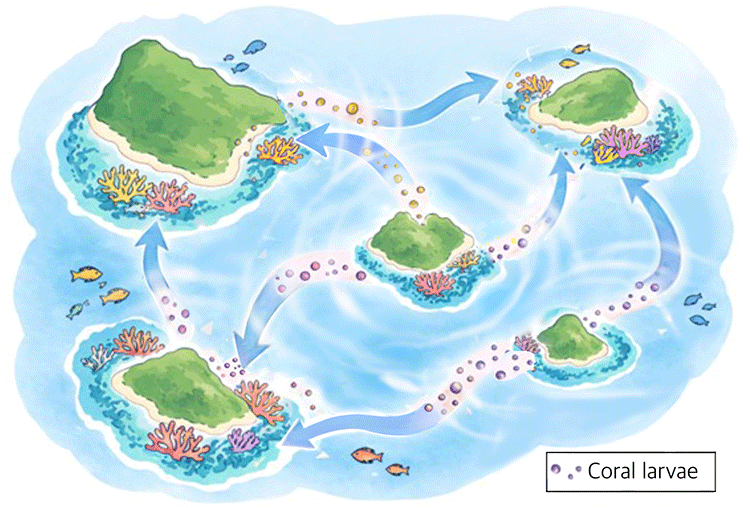
Conceptual diagram of coral planktonic larvae dispersing via ocean currents
The coral reef ecosystems of Japan’s Nansei Islands possess a high level of biodiversity even by global standards. However, in recent years, they have been deteriorating rapidly due to factors such as mass coral bleaching associated with climate change. Corals form the foundation of these ecosystems and facilitate the exchange of individuals and genes among the islands by dispersing their planktonic larvae, which are carried by ocean currents. Maintaining the health of coral reef ecosystems requires elucidating the ecological networks that govern how coral populations are connected and sustained. Then, conservation plans must/can be formulated based on this understanding. Furthermore, identifying the source regions of coral individuals, which serve as the core of this inter-island exchange, will help prioritize conservation efforts.
Historically, ecological networks among coral reefs have been inferred primarily through population genetic analyses. These analyses evaluate genetic similarity and divergence among coral populations. However, they produce complex results that are difficult to interpret. For example, geographically distant coral reefs may be genetically closely related, which makes it challenging to grasp the overall picture of ecological networks. Furthermore, restrictions on collecting corals, which are conservation target species, make it difficult to obtain sufficient samples. Although studies using ocean current models had suggested that the Kuroshio Current might promote the dispersal of coral larvae, this had not been verified through a comparative analysis of population genetic data.
Researchers at AIST visualized the ecological network of coral reef ecosystems and identified the regions serving as sources of coral individuals in the Nansei Islands (Figure 1).
Elucidating the marine ecological networks that link coral reef ecosystems helps us understand how entire regions’ ecosystems are established and maintained. This provides critical information for biodiversity conservation. In the Nansei Islands, the genetic connections between corals on different islands have primarily been investigated using population genetic analysis. However, these connections are complex, making it difficult to adequately visualize and evaluate the ecological networks between coral reefs. In this study, we combined population genetic analysis with ocean current models to estimate the regions that serve as sources of coral individuals connecting the islands. This method is not based on geographical distance, but under conditions that reflect ocean currents. These findings are expected to provide foundational information for conserving coral reef ecosystems in the Nansei Islands.
Journal: Scientific Reports
Title of paper:Kuroshio Corridor: larval dispersal networks explain geographically independent connectivity among coral habitats in Japan
Authors: Naoki Saito, Hiroki Kise, Yuichi Nakajima, Akira Iguchi
DOI:https://doi.org/10.1038/s41598-026-40448-z