―Towards application to hardware-based brainmorphic systems that simulate brain functions―
Researchers) YAMAMOTO Tatsuya, Senior Researcher, NOZAKI Takayuki, Research Group Leader, Research Institute for Hybrid Functional Integration, YUASA Shinji, Senior Principal Researcher, Department of Electronics and Manufacturing
- A magnetic memristor was developed using a magnetic data storage layer made of an atomically flat iron-manganese alloy ultrathin film.
- Synaptic function was emulated by using a circular nanopillar device with a diameter of 200 nanometers.
- Magnetic memristors operating at high-speed and compatible with large scale integration promise future applications in brainmorphic systems.
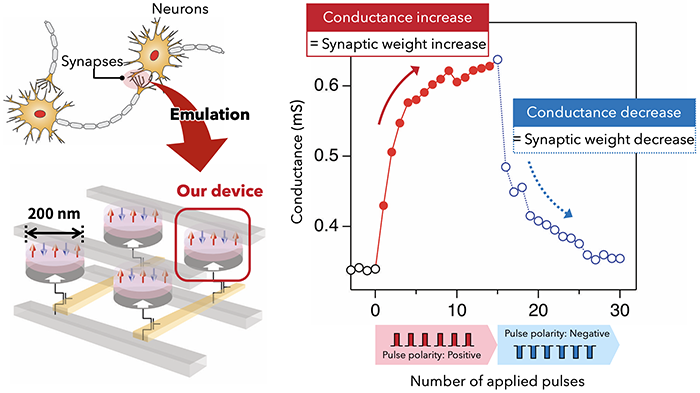
Concept of magnetic memristor developed in this study and an example of synaptic functions emulated by using the magnetic memristor
*This figure is based on and modified from the original paper.
Brainmorphic systems are computing systems that emulate the brain functions of animals including humans through electronics. As numerous neurons operate simultaneously in the brain, brainmorphic systems employ artificial components that mimic the functionalities of the brain's constituent organs. For example, neuron-like elements in the brainmorphic systems operate in parallel and simultaneously. While existing computing systems require significant energy for information processing in artificial intelligence (AI) architectures, brainmorphic systems are expected to work at a much lower power consumption.
Synapses play the following roles in the brain: transmission of signals between neurons, memorizing past experiences, and regulating the signal strength according to these memories. These functions are more specifically known as “long-term potentiation” (LTP) and “long-term depression” (LTD), which strengthen and weaken the synaptic connections, respectively. The LTP and LTD are considered as the basis of learning and memory in the brain. In the brainmorphic systems, learnable hardware elements such as memristors and resistive random-access memory (ReRAM) handle these functionalities. While memristors and ReRAM can inherently mimic the synaptic functions, the brainmorphic systems requires them to have unlimited endurance (infinite information update cycles) and large-scale integration capability in addition to high-speed operation. Although ReRAM-based memristors are currently dominant in R&D, they suffer inherent limitations in their endurance.
Magnetic memristors use stepwise reversal of magnetization in magnetic tunnel junction (MTJ) devices and are anticipated as electrical elements capable of achieving high-speed operation as well as unlimited endurance. Currently, Co-Fe-B (cobalt-iron-boron) alloy is the only mass-producible MTJ material for practical use. However, its magnetization favors uniform reversal due to its soft magnetic property. This makes it difficult to retain a partially reversed magnetization in the magnetic data storage layer. Thus, in order to function as a memristive element, the existing magnetic memristors must be fabricated into fine lines on the micrometer scale. Consequently, the device size is more than one order of magnitude larger than that of ReRAM, making it unsuitable for high-density integration.
In collaboration with the National Institute for Materials Science, we, researchers at AIST, have developed magnetic memristors that can be integrated at high densities and operate at high speeds. These magnetic memristors use an ultrathin film of a magnetic iron-manganese alloy in which the alloy composition fluctuates periodically on the scale of several nanometers. These nanostructures are formed spontaneously through heat treatment. Furthermore, researchers successfully used these devices to emulate the synaptic function of the brain.
Brainmorphic systems are a new type of computing system that operates by emulating the information processing in human and animal brains. The use of brainmorphic systems is expected to drastically reduce the power consumption in AI architectures. In the brain, synapses transmit signals between neurons and demonstrate long-term potentiation (LTP) and long-term depression (LTD), processes that strengthen or weaken information transmission. Magnetic memristors are a promising candidate that can perform these synaptic functions while enabling high-speed operation and high endurance. However, device structures suitable for high-density integration were still missing.
Here, we developed a simple, fine circular pillar device with a 200-nanometer diameter using an iron-manganese alloy as the magnetic data storage layer. Stepwise resistance control is enabled by forming nanometer-scale magnetic subdivisions within the magnetic storage layer through spinodal decomposition. Furthermore, we successfully reproduced fundamental synaptic learning functions, including LTP and LTD, using these magnetic memristors. Practical brainmorphic systems capable of high-speed operation are expected to benefit from this achievement.
Journal:Advanced Functional Materials
Title of paper:Spinodal Magnetoresistive Memristors
Authors:T. Yamamoto, T. Ichinose, J. Uzuhashi, S. Tsunegi, T. Nozaki, T. Ohkubo, S. Tamaru, K. Yakushiji, H. Kubota, and S. Yuasa
DOI:10.1002/adfm.202523154