National Metrology Institute of Japan
Development of LED-Based Standard Light Source
that Emits Light in All Directions
- NAKAZAWA Yuri, GODO Kenji
Research Institute for Physical Measurement
Released: August 30, 2021
World’s first LED-based, spectrally optimized omnidirectional standard light source
The researchers developed a prototype of an omnidirectional standard LED; it is a new standard light source based on LEDs that emit light covering the full visible wavelength range in all directions.
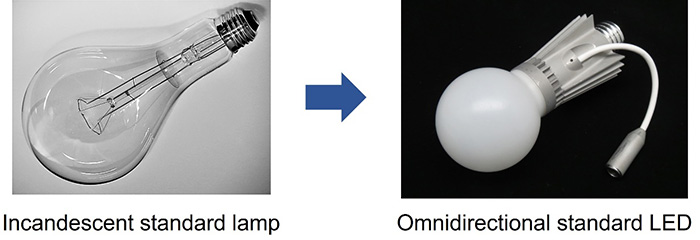 Developed prototype of an omnidirectional standard LED
Crisis of the incandescent standard lamp, seeking for a “new generation” standard light source
In order to correctly determine the total luminous flux of a light source with the accuracy required by manufacturers, it is necessary to use a standard light source having similar characteristics (spatial light distribution, light source size, and total luminous flux) with respect to each product. However, with the spread of LED lighting in recent years, the production of incandescent lamps has been significantly reduced or discontinued not only for consumer use but also for standard light sources. Therefore, a novel “non-incandescent” standard light source is strongly demanded among the lighting industry.
Achieves both omnidirectional distribution and full coverage of entire visible wavelength range
The researchers had previously succeeded in developing LED-based highly stabilized, spectrally optimized standard light source with forward emission. By incorporating a specially designed cap-type optical component that directs light backward in a diffusion dome, they succeeded in developing an omnidirectional LED light source to be used as a standard light source. This prototype has totally uniform spatial distribution in any directions except for the lamp base, while maintaining the entire coverage of the visible wavelength range.
Optimize thermal design for practical-level total luminous flux
While considering the balance between output and size of the light source, the researchers are currently working towards optimizing design of the heat sink to allow higher operating current—aiming to achieve a practical level of total luminous flux.
* This research was conducted in collaboration with Nichia Corporation.
Contact for inquiries related to this theme
Photometry and Radiometry Research Group, Research Institute for Physical Measurement,
National Metrology Institute of Japan
NAKAZAWA Yuri, Senior Researcher
AIST Tsukuba Central 3, 1-1-1 Umezono, Tsukuba, Ibaraki 305-8563 Japan
E-mail: opt-rad-ml*aist.go.jp (Please convert "*" to "@".)
Applied Optical Measurement Group, Research Institute for Physical Measurement,
National Metrology Institute of Japan
GODO Kenji, Senior Researcher
AIST Tsukuba Central 3, 1-1-1 Umezono, Tsukuba, Ibaraki 305-8563 Japan
E-mail: info-apprad-ml*aist.go.jp (Please convert "*" to "@".)