Department of Life Science and Biotechnology
Department of Energy and Environment
A mutual cooperation mechanism whereby symbiotic bacteria make pest insects resistant to insecticides
- KIKUCHI Yoshitomo
Bioproduction Research Institute
- SATO Yuya
Environmental Management Research Institute
Released: November 10, 2021
Host insects and symbiotic bacteria help each other to detoxify insecticides
We identified the gene essential for detoxifying insecticides in the symbiotic bacterium that lives in the gut of a pest stink bug. The insecticide entering into the stink bug body is broken down by the symbiotic bacterium using this enzyme gene. Notably, the degradation product of the insecticide is toxic to the symbiotic bacterium itself, but the stink bug immediately discharges it out of the body. As a result, while the symbiotic bacterium degrades the insecticide and produces the bactericidal degradation product, the symbionts can survive in the stink bug body because the host insect efficiently excludes the bactericidal product. This discovery opens up the possibility of new pest control methods targeting the insecticide degradation gene of the symbiotic bacterium.
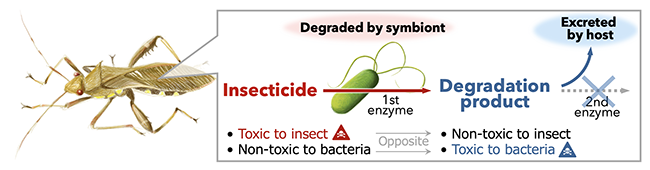 Relationship between the insect and the symbiont bacterium involved in the insecticide detoxification
Understanding the mechanisms by which pests gain the insecticide resistance is required, in order to develop new insecticides
Insecticides are widely used in contemporary agriculture and for public hygiene, but continuous use of a single insecticide may lead to the emergence of pests resistant to it. This is due to the insect's own genetic mutation that changes the structure of the protein targeted by the insecticide. Furthermore, it has also been found recently that the symbiotic bacteria in insects play an important role in the detoxification of insecticides. However, to date, the mechanism of the insecticide detoxification processes through symbiotic bacteria remains unclear.
We found that the pest insect and the symbiont bacterium interact during the insecticide detoxification process
We investigated how the symbiotic bacterium detoxifies the insecticide in the intestines of the pest stink bug and identified the gene essential for the detoxification in the symbiont bacterium. The symbiont bacterium works with this gene to break down the insecticide that enter the pest insect body. However, it was found that the degradation product of the insecticides is toxic to the symbiont bacterium itself, but non-toxic to the host insect. This bactericidal substance is immediately excreted from the insect body. As a result, while the symbiont bacterium degrades the insecticide and produces the bactericidal degradation product, the symbionts can survive in the stink bug body.
Exploration of substances that inhibit the functional expression of genes responsible for the insecticide resistance
Since the genes responsible for the insecticide resistance has been identified in the symbiotic bacterium, we will proceed with screening substances that target this gene and inhibit resistance, and move forward with research and development to an insecticide by investigating insecticide-degrading bacteria. In addition, we will investigate the genes involved in the excretion of insecticide-degradation products in pest stink bugs, and move forward with research and development of technologies that break the mechanism for co-survival through the interaction of symbiotic bacteria and host insects.
Contact for inquiries related to this theme
Environmental Biofunction Research Group, Bioproduction Research Institute
KIKUCHI Yoshitomo, Leader, Group
2-17-2-1 Tsukisamu-Higashi, Toyohira-ku, Sapporo, Hokkaido 062-8517 Japan
E-mail: bpri-webmaster-ml*aist.go.jp (Please convert "*" to "@".)
Environmental Function Engineering Research Group, Environmental Management Research Institute
SATO Yuya, Senior Researcher
16-1 Onogawa, Tsukuba, Ibaraki 305-8569 Japan
E-mail: emri-web-ml*aist.go.jp (Please convert "*" to "@".)