Development of a New Crystalline Silicon Solar Cell
- MATSUI Takuya, SAI Hitoshi
Global Zero Emission Research Center
Released: October 22, 2020
High efficiency, low cost solar cells using titanium oxide
The ability of titanium oxide to selectively extract holes from silicon was discovered, and a silicon solar cell with a titanium oxide thin film placed on the positive electrode side was fabricated and achieved conversion efficiency in excess of 20%.
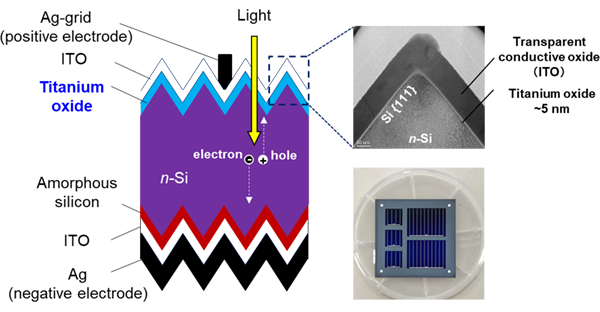 |
| Conceptual diagram of fabricated solar cell structure (example) (left), transmission electron microscopy image of interface between silicon and titanium oxide (upper right), and appearance of a sample with five solar cells formed on a 50 mm square crystalline silicon substrate (lower right) |
Both improved conversion efficiency and reduced manufacturing costs
Crystalline silicon solar panels presently account for over 90% of the market. Pursuit of energy conversion efficiency increases manufacturing costs. In order to promote the introduction of solar power generation, it is necessary to simultaneously increase conversion efficiency and reduce manufacturing costs.
Use of titanium oxide in the positive electrode to improve conversion efficiency
It was demonstrated that a titanium oxide thin film with a thickness of approximately 5 nm exhibits both hole selectivity and the ability to inactivate surface defects of silicon (passivation), and can function as a positive electrode. The mechanism of these properties was investigated, and the results clarified that the passivation and hole selectivity can be controlled by the composition and distribution of the intermixed layer consisting of titanium, silicon, oxygen, and hydrogen present at the interface between the titanium oxide and the crystalline silicon. In addition, a prototype crystalline silicon solar cell with a titanium oxide thin film placed on the positive electrode side was fabricated and achieved conversion efficiency in excess of 20%.
A new ability of titanium oxide expands the range of application
Titanium oxide is a material known to inherently exhibit electron selectivity for silicon, and this research confirmed that hole selectivity can also be realized. Going forward, we intend to develop solar cells with a simple structure that applies titanium oxide to both positive and negative electrodes of silicon. Application of the newly developed technology can be expected to tandem solar cells that stack heterogeneous solar cells and silicon solar cells, and to photoelectrochemical devices and semiconductor devices, etc.
Contact for inquiries related to this theme
Multijunction PV Team, Global Zero Emission Research Center
MATSUI Takuya, Chief Senior Researcher,
SAI Hitoshi, Senior Researcher
AIST Tsukuba Central 2, 1-1-1 Umezono, Tsukuba, Ibaraki 305-8568 Japan
E-mail: gzr-info-ml*aist.go.jp (Please convert "*" to "@".)