Towards the Realization of Automobiles That Are Environmentally-Friendly in Both Materials and Operation
- OKADA Shusuke, TAKAGI Kenta
Magnetic Powder Metallurgy Research Center
Update(MM/DD/YYYY):12/24/2020
Development of a heavy rare earth-free magnet powder having unprecedentedly high coercivity
The researchers have developed a samarium-iron-nitrogen magnet powder with a coercivity of 30 kOe or more at room temperature without the use of heavy rare earth elements by using a rotary heat treatment technology tailored to a reduction-diffusion reaction.
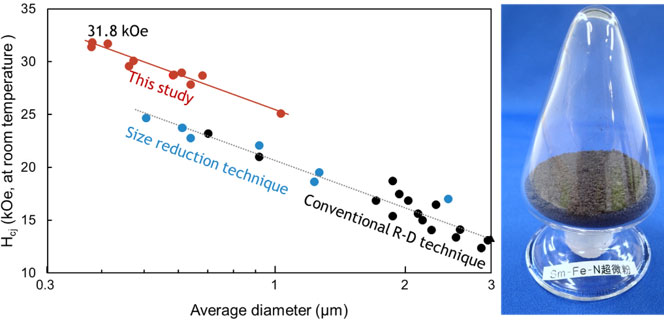 |
| Relationship between particle diameter and room-temperature coercivity of samarium-iron-nitrogen (Sm2Fe17N3) fine magnet powders synthesized using developed process and conventional process (left), and photograph of developed magnet powder (right) |
Higher heat resistance demanded in magnets in order to increase performance of hybrid vehicles
Because the internal temperature of automotive drive motors can increase to approximately 200 ºC, high residual magnetization and high heat resistance are required for the magnets employed in these motors. The neodymium-iron-boron magnets (neodymium magnets) currently in use suffer a drastic reduction in coercivity at high temperatures; the heat resistance of these magnets is therefore strengthened by the addition of heavy rare earth elements such as dysprosium and terbium. However, given the instability in both the cost and the supply of heavy rare earth elements, there is a demand for the development of high-performance, high-heat-resistance heavy rare earth-free magnets.
New technology for the equalization of magnet powder size at a sub-micrometer level
In order to increase the coercivity of a samarium-iron-nitrogen magnet powder, it is necessary to make the reduction-diffusion reaction system uniform. The researchers have therefore developed a rotary heat treatment technology enabling simultaneous multiphase agitation and heat treatment in an airtight space. In addition, the technology for the reduction of particle size developed to date has made it possible to realize an unprecedentedly high level of coercivity for a heavy rare earth-free rare earth-iron magnet powder (approximately 32 kOe at room temperature, equating to approximately 11 kOe at 200 ºC, which represents a yardstick for application in automotive drive motors). Due to the superior heat resistance of the developed magnet powder, it is expected to be employed in the future in magnets that exceed the performance of neodymium magnets under high-temperature conditions.
Towards the development of a sintering technology that will be essential to the realization of higher performance and practical use.
The researchers will increase the dispersibility of the developed magnet powder in order to improve its orientation and increase residual magnetization. They will also develop a sintering technology for the developed magnet powder.
Contact
OKADA Shusuke, Senior Researcher
TAKAGI Kenta, Leader, Team
Hard Magnetic Materials Team, Magnetic Powder Metallurgy Research Center
AIST Chubu, 2266-98 Anagahora, Shimo-Shidami, Moriyama-ku, Nagoya, Aichi 463-8560 Japan
E-mail: magmet_contact-ml*aist.go.jp (Please convert “*” to “@”)