―Development of a compact current comparator capable of evaluating both AC and DC current ratios using the same setup―
Researchers) AMAGAI Yasutaka Team Leader, KAINUMA Yuta Researcher, Global Research and Development Center for Business by Quantum-AI Technology (G-QuAT), MURAMATSU Hidekazu Researcher, Research Institute for Physical Measurement, KATO Hiromitsu Research Team Leader, Advanced Power Electronics Research Center
- Diamond quantum sensors were introduced into current comparators to calibrate current measurement instruments for AC and DC.
- Using the same device configuration, both the AC current ratio and the DC current ratio were evaluated with high precision, while the size and mass of the central section were reduced to less than one-third the size and less than one-tenth the mass of conventional current comparators.
- As a foundational technology for unifying the calibration systems, which were previously divided into either AC or DC, it is expected to contribute to streamlining the calibration of current measurement instruments and standardizing current measurement in next-generation power grids.
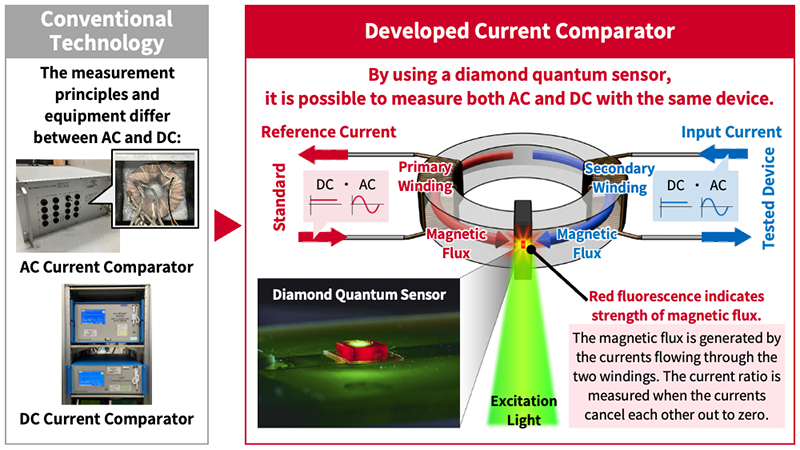
*The figures used here are adapted from those in the original paper.
Researchers at AIST, in collaboration with the Institute of Science Tokyo and the National Institutes for Quantum Science and Technology, have developed a “current comparator” that uses diamond quantum sensors to accurately evaluate both AC and DC current ratios using the same device setup.
A current comparator is a device for the calibration of current measurement instruments employed in electric power generation, transmission, and distribution facilities. Because the measurement principles differ between AC and DC, separate current comparators are conventionally used for AC and DC current ratios, and separate calibration systems are established for each. Establishing measurement technology and a calibration system capable of handling both types uniformly is a key challenge in promoting the wider and more efficient adoption of highly reliable current measurement throughout society.
In this study, we demonstrated that both AC and DC current ratios can be evaluated with high precision using the same setup based on a diamond quantum sensor that detects the magnetic fluxes generated by electric currents. Furthermore, by eliminating the need for the detection coil based on electromagnetic induction, which is typically used in conventional AC current ratio measurements, we succeeded in miniaturizing the core component of the current comparator. This development paves the way for the unification and streamlining of calibration systems for current measurement instruments. This progress is expected to contribute to the standardization of current measurement in next-generation power grids where AC and DC coexist due to the proliferation of renewable energy sources.
The electric power grid that supports our daily lives consists of various facilities, such as power plants, power transmission and power distribution equipment. Accurate current measurements are essential for the operation, maintenance, and expansion of power generation, transmission, and distribution facilities. Since these power systems handle high currents of up to several hundred amperes, these currents cannot be fed directly into measuring instruments. Therefore, current transformers are used to convert the current to a smaller value, typically around a few amperes, that is easier to measure. In this process, it is crucial to accurately determine the ratio between the original current and the converted current (the current ratio), and current comparators are used for this purpose. AC and DC current ratios are conventionally measured using different principles and separate calibration systems. Conventional current comparators used for AC current ratio measurement employ a measurement principle based on electromagnetic induction. While they can measure AC current ratios, they cannot measure DC. Consequently, different principles and different instrument configurations are used for evaluating AC and DC current ratios, respectively. Establishing measurement technologies and calibration systems capable of handling both uniformly has been a challenge in promoting the wider and more efficient adoption of highly reliable current measurements throughout society. Solving this challenge would eliminate the need to maintain separate measurement systems and calibration systems for AC and DC, thereby resolving the complexity associated with instrument configuration and data management.
Journal: Scientific Reports
Title of paper:Current comparator for both AC and DC ratio measurements with 10-8-level type-a uncertainty Authors: Hidekazu Muramatsu, Yuta Kainuma, Hiromitsu Kato, Norihiko Sakamoto, Tatsuji Yamada, Chiharu Urano, Hiroshi Abe, Shinobu Onoda, Takeshi Ohshima, Yuji Hatano, Mutsuko Hatano, Nobu-Hisa Kaneko, Yasutaka Amagai, and Takayuki Iwasaki
DOI: https://doi.org/10.1038/s41598-026-58868-2