―Toward a Next-Generation Photon-Count Identifier for Realizing an Optical Quantum Computer Capable of Deriving Correct Solutions Through Large-Scale Computation―
Researchers) FUKUDA Daiji Principal Researcher, TSURUTA Tetsuya Tsuruta Senior Researcher, Quantum Photonics Hardware Research Team, Quantum Sensor Measurement Research Group, Global Research and Development Center for Business by Quantum-AI technology (G-QuAT), Research Institute for Physical Measurement
- Demonstrated a new principle for counting photons by directly observing the magnetic flux quanta generated by photons and reading them out as quantized voltage signals
- Paved the way for a new type of photon counter that is expected to operate at high speeds and is independent of thermal response
- Progressed toward the realization of a high-speed photon counter applicable to quantum error correction in optical quantum computer
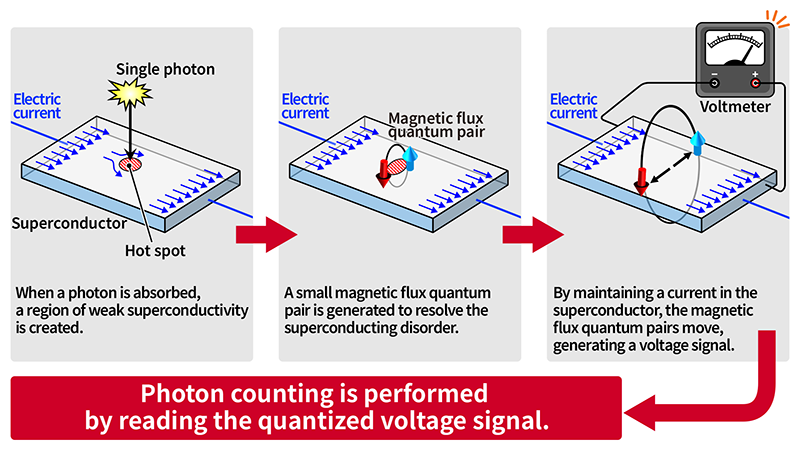
An illustration of the principle behind detecting photons using magnetic flux quanta.
In optical quantum computing, the use of photons as qubits is expected to enable high-speed, large-scale quantum computations, while in quantum communication, the use of photons as carriers of quantum information is expected to enable communication with high information-theoretic security. To advance these quantum photonic technologies, it is necessary to detect photons with high efficiency and precision. In particular, photon number-resolved detection (PNRD), which not only detects the presence or absence of a photon but also distinguishes the exact number of photons (1, 2, 3, etc.), is a critical technology with anticipated applications in the evaluation of single-photon sources, bosonic quantum computing, and advanced quantum communication schemes. While PNRD has been used as a key measurement technique in quantum optics research, further speed improvements are required for its future deployment in large-scale optical quantum computers and quantum communication infrastructure.
Typical photon detectors include superconducting transition-edge sensors (TES) and superconducting nanowire single-photon detectors (SNSPD). While TES devices offer excellent capability to resolve individual photon numbers up to multiple photons, they measure photon energy as heat, which requires dwell time for cooling and thus restricts how fast a TES device can operate. In contrast, SNSPDs operate extremely quickly. However, while they can detect the arrival of a photon, they cannot determine its energy. Therefore, to function as a PNRD and distinguish the number of photons, it is necessary to combine numerous detectors.
Currently, achieving both the high photon-number-resolving capability of TES and the high speed of SNSPD remains a significant technical challenge. To achieve both, a new method of optical detection is required, rather than simply refining existing technologies.
Researchers at AIST have succeeded in directly observing magnetic flux quanta generated in a superconductor by photon absorption and have demonstrated a new principle of photon detection that identifies the number of photons based on the number of these flux quanta.
Detecting individual photons is a key technology for photon quantum computers and quantum communication, and several methods have been proposed. While some of these methods are already in practical use for research purposes, their integration into industrial applications has just begun. In this study, a new approach to photon detection simultaneously combines both important capabilities, the high photon-number-resolving capability, which is difficult to achieve with the above-mentioned conventional technologies, and the capability to operate at high speed, which is desirable for industrial applications.
When a photon is absorbed by a superconductor, the gradient of the superconducting phase becomes unstable, generating a pair of magnetic flux quanta. As these magnetic flux quanta traverse the superconductor, phase slip occurs, resulting in a quantized voltage signal generated by the Josephson effect. In this study, observation of this quantized voltage signal allows to directly identify the number of incident photons.
Conventional superconducting photon-counting detectors measured temperature changes upon reaching thermal equilibrium after photon absorption. In contrast, this technology utilizes the dynamics of the superconducting phase that occur immediately after light absorption. Since there is no need to wait for a thermal response, this approach is expected to lead to high-speed photon-counting technology that surpasses conventional methods.
Journal: Physical Review Applied
Title of paper: Direct observation of photon-induced vortices in superconducting films
Authors: Takeshi Jodoi, Fuminori Hirayama, Tetsuya Tsuruta, Takahiro Kikuchi and Daiji Fukuda
DOI: https://doi.org/10.1103/n295-rfl8