―Specially designed patterned polarizing sheets molded in a single step via nanoimprint technology―
Researchers) The Core Manufacturing Technology Research Institute, HOKARI Ryohei, Senior Researcher, KUWANO Genki, Senior Researcher, TSUJIOKA Kazuma, Researcher, KURIHARA Kazuma, Research Manager
- Simply sliding two stacked polarizing sheets a few millimeters enables multi-stage control of transmittance.
- This approach achieves flat blinds with minimal visual disruption and easy maintenance using power-free polarizing sheets.
- There are high expectations for applications in energy-saving technologies that control not only visible light but also heat shielding (infrared).
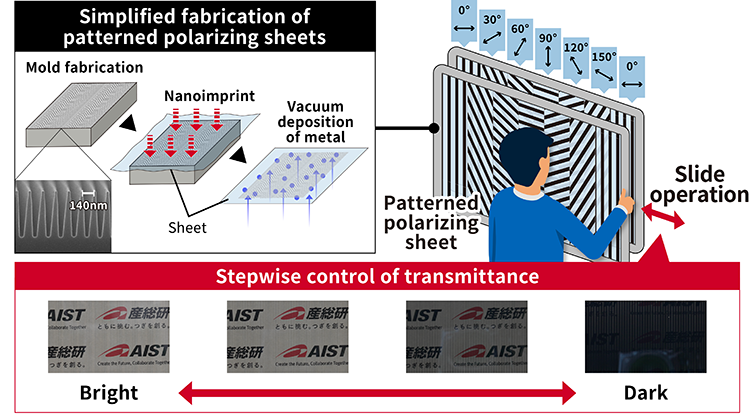
Overview of the Developed Multi-Stage Dimming Blinds
Light-adjusting technology is used in windows, blinds, lighting, eyewear, and more, to support daily life. Blinds are important for achieving carbon neutrality because they not only adjust light but also provide heat-blocking effects, which contribute to energy savings.
Looking at office windows with blinds installed, it's common to see many places where the blinds are always closed. Opening, closing, and adjusting their angle can be cumbersome, and moving them can stir up dust. However, it is widely recognized that looking out the window can help refresh the mind and reduce stress. In light of this trend, there is an increasing demand for light-adjusting blinds that are easy to install and operate. In addition, there is also a growing demand for light-adjusting functions in building and vehicle windows because of the following main reasons: energy savings, comfort through light and heat blocking, and privacy protection.
Traditional dimming blinds using polarizing films can be manufactured by cutting the films to align their polarization axes vertically and horizontally, then alternating and laminating them. While this method allows switching between light and dark states, achieving gradual dimming is difficult. Electric dimming windows that use liquid crystals or similar materials can achieve stepwise dimming; however, they are more expensive and require complex power supplies and wiring installations. Consequently, there was a demand for sheet-type dimming blinds that are easy to process and install, simple to implement, and capable of dimming without requiring a power source.
Researchers at AIST have developed multi-stage dimming blinds that are easy to process, install, and implement. These blinds utilize a unique nano-structured polarizing sheet.
Blinds and curtains control the amount of natural light entering through windows to adapt to daily rhythms and lifestyles. In recent years, dimmable glass using liquid crystals has taken part of this role, but its implementation is limited because it requires a power source for control.
The newly developed dimming blind allows multi-stage adjustment of light transmittance, which was previously limited to an ON/OFF setting, simply by sliding two layered sheets a few millimeters. This enables one-handed, effortless adjustment to a comfortable brightness level when sunlight feels too glaring. The sheets can be mass-produced using nanoimprint technology with specially designed polarization patterns. Since no power source is required to control light transmittance and it can also modulate near-infrared and infrared light, it is expected to be used for adjusting heat-shielding effects, which is a need in residential settings. Furthermore, future applications are anticipated in a wider range of fields, such as use in sensor peripheral components.